
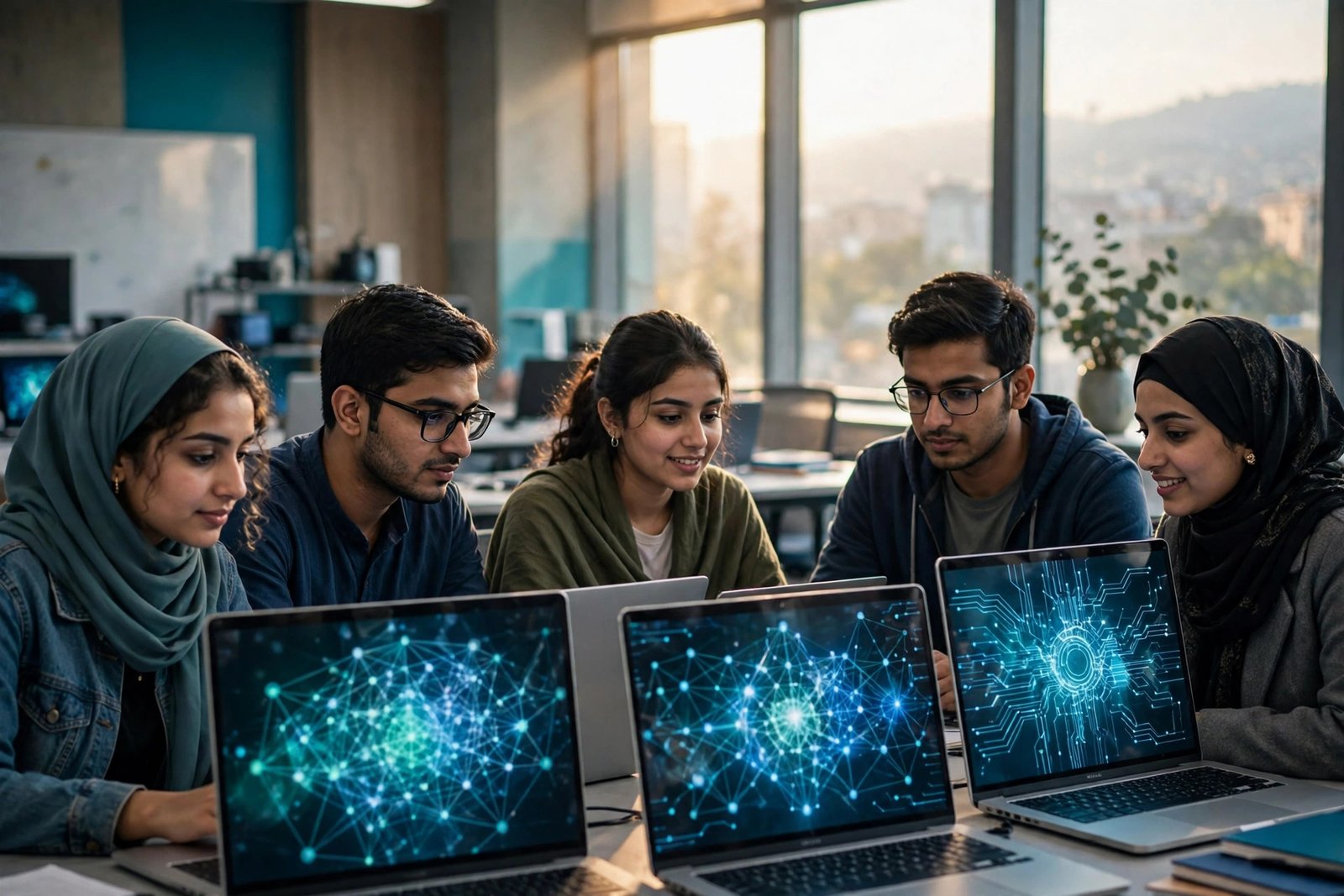
Pakistan plans to train one million AI professionals by 2030, under its National AI Policy. Planning Minister Ahsan Iqbal announced the target on Thursday, 5 November 2026, while addressing the Pakistan–Russia IT Collaboration: Industry Engagement Framework in Islamabad. The goal is part of a wider push to turn Pakistan into a trillion-dollar economy by 2035 — and it could reshape hiring, freelancing and digital business in the country within a few years.
1The Announcement in Brief
According to The Nation, the minister said developing one million artificial intelligence professionals by 2030 was a core aim of the National AI Policy, as part of the government’s broader strategy to strengthen the digital economy. The announcement came at an industry event focused on expanding technological cooperation between Pakistan and Russia.
The plan sits inside a bigger framework. Iqbal said “e-Pakistan” — the digital pillar of the National Economic Transformation Plan — is one of five core pillars of the government’s economic strategy, with the stated aim of transforming Pakistan into a trillion-dollar economy by 2035.
2What the Plan Includes
The announcement is not just a headline number. Several concrete pieces were laid out:
- One million AI professionals by 2030. The National AI Policy sets this as the headline target for the country’s AI workforce.
- Seven new AI centres. These would connect research, skills development, startups and industry to strengthen Pakistan’s AI ecosystem, according to the minister.
- A large graduate base to build on. Pakistan produces more than 75,000 graduates every year, which the minister pointed to as the human-resource foundation for the plan.
- A shift from services to products. Iqbal stressed that Pakistan needed to move beyond exporting IT services towards developing products and digital platforms for international markets — a significant change in emphasis for an industry that has long sold hours rather than products.
3The Pakistan–Russia Angle
The event where the announcement was made was itself part of the story. The Pakistan–Russia IT Collaboration framework is aimed at turning business discussions into commercial contracts, with joint ventures, technology partnerships and market access on the agenda.
Recent business-to-business meetings organised by the Pakistan Software Export Board (PSEB) in collaboration with P@SHA showed the potential: five Russian companies held 16 meetings with 11 Pakistani firms. Cooperation could focus on automation and enterprise software for industry, digital supply chains for agriculture, secure digital systems for trade, artificial intelligence, cloud computing and cybersecurity.
The minister also said the two countries could jointly develop, integrate and deliver technology solutions in their own markets as well as in third countries, and that Russia’s longstanding scientific and engineering expertise complemented Pakistan’s engineering talent and international technology delivery experience.
4The Digital Foundations Behind the Target
The announcement also pointed to digital systems Pakistan already has in place. Iqbal highlighted the internationally recognised digital identity system of the National Database and Registration Authority (NADRA) and the performance of the instant payment system RAAST, which processed 646 million transactions in a single quarter.
Those two systems matter because they are the kind of large-scale digital infrastructure that AI projects are built on: verified identity and instant payments are the rails that digital businesses, fintech products and AI-powered services run on. Pakistan already has them at national scale.
AI tools are only as useful as the digital foundations beneath them. NADRA identity and RAAST payments give Pakistani businesses two building blocks most emerging markets do not have — and they are exactly what AI-powered products need to work at scale.
5The Honest Caveats
The minister did not present the plan as a done deal. He was clear that the success of such forums should be measured “not by announcements but by the trade, investment and employment opportunities they generated” — and urged participants to leave the session with specific business opportunities, identified counterparts and agreed follow-up steps.
Two practical obstacles were named openly. Payment and settlement mechanisms remain a challenge for closer Pakistan–Russia business, with relevant institutions working to address them. And there is a language barrier: the limited availability of Russian-language expertise among Pakistani academics and researchers has already cost Pakistani students and researchers access to some scholarships. The government is working to promote Russian-language education through a centre at Allama Iqbal Open University and in collaboration with the Higher Education Commission.
He closed with a line that summed up the ambition: “Energy has powered our partnership for years. Now, let’s let technology power our future.”
6What This Means for Pakistani Businesses
Announcements are cheap; the question for any business owner, freelancer or job seeker is what changes on the ground. Here is our read.
1. AI skills are about to become the most hireable skill in Pakistan
A national target of one million AI professionals means a flood of training programmes, certifications and AI centres over the next few years. Businesses that hire now — even one person who can use AI tools for content, customer support, data analysis or automation — will be ahead of competitors who wait for the talent pool to mature. If you run a small business, the cheapest first step is not hiring a data scientist: it is training your existing team to use AI tools for the work they already do.
2. Freelancers should treat AI as a rate multiplier, not a threat
Pakistan’s freelance economy is already one of the world’s largest, and AI skills command a premium on global platforms. A developer or marketer who can build with AI tools, automate workflows or analyse data with AI will earn more than one who cannot. The government’s own target signals where the demand is heading — and the free and low-cost AI training now appearing across Pakistan, including Google’s AI programmes, is the fastest way in. For context, Google’s growing presence in Pakistan keeps putting practical AI tools within reach of ordinary businesses. (We covered Google’s recent AI moves for Pakistani businesses in our earlier news post on Pakistani apps crossing 4.6 billion downloads.)
3. The shift from services to products is the real opportunity
The most important sentence in the announcement may be the one about moving beyond exporting IT services towards developing products and digital platforms. Pakistan’s software houses have spent years selling hours. Products — SaaS tools, apps, platforms — scale in a way hours never do. For agencies and startups, this is the direction the policy wind is blowing: build something that sells while you sleep, not only something that bills by the hour.
4. SMEs get a window to digitise before the competition does
Seven AI centres connecting research, startups and industry will eventually produce tools, talent and partnerships that small businesses can use. But the businesses that benefit first will be the ones already digital: a proper website, online payments, a Google Business Profile, and basic SEO. AI cannot market a business that does not exist online. If your business is still invisible on Google, that is the gap to close first — and it costs far less than most owners assume. (See our 2026 digital marketing cost guide for Pakistan for realistic numbers.)
5. Watch the follow-through, not the headline
One million professionals by 2030 is an ambitious target, and the minister himself said success should be judged by jobs and trade, not announcements. The honest way to read this story is as a direction of travel: the government is betting heavily on AI skills, the training pipeline is being built, and the businesses that align with it early will have the pick of talent, partnerships and funding. Keep an eye on the AI centres, the certification programmes and the PSEB–P@SHA pipeline — and position your business to use them when they arrive.
7The Bottom Line
Pakistan’s one-million-AI-professionals target is a bold statement of intent, backed by a National AI Policy, seven planned AI centres and a graduate base of more than 75,000 a year. For businesses, the message is simple: AI skills are becoming the core currency of Pakistan’s digital economy, and the time to start building them — in your team, in your products and in yourself — is now, while the training is new and the competition is still thin.

Get Your Business Ready for the AI Economy
At Azhad Niaz & Company in Peshawar, we help Pakistani businesses get ready for exactly this shift: modern websites, SEO that brings customers, and the digital foundations AI tools are built on.